The material a menu cover is made from changes almost everything about it: how it feels in a guest’s hands, how long it survives a busy service, how often it needs replacing, and what it signals about the room before anyone reads a word. Before you order a stack of leather menu covers or default to the cheapest clear pocket, it helps to understand what actually separates the options and where each one earns its price.
The three materials behind most restaurant menu covers
Nearly every cover on the market is built from one of three families. Clear vinyl and PVC sleeves are the workhorses: a printed insert slides into a transparent pocket that wipes clean in a second and shrugs off spilled sauce and condensation. They photograph as “plastic,” which is exactly right for a high-volume diner, a cafe counter, or a laminated drink list that changes weekly. Leatherette, also sold as faux leather or leatherette, is a rigid board wrapped in a coated vinyl or bonded skin. It holds a square, structured shape, comes in a wide range of colors and stitched-edge finishes, and takes a foil-stamped logo cleanly, which is why it dominates casual and family restaurants. Genuine leather sits at the top: softer in the hand, warmer in tone, and able to develop a patina, it reads as fine dining the moment a guest picks it up.
The trade-off is not just cost. Vinyl and leatherette are the easiest to sanitize between guests because a damp cloth is all they need, while real leather asks for a dry wipe and the occasional conditioner and does not love standing water. If your covers live near an ice well or an outdoor patio, that maintenance difference matters more than the look.
Matching size and view count to your menu
Menu covers are built around standard paper sizes, so the first decision is which insert you are printing. The common full sizes are 8.5 x 11 inches (letter), 8.5 x 14 inches (legal, a favorite for wine and cocktail lists because it gives long vintage columns room to breathe), and 11 x 17 inches (tabloid) for large all-day menus. Slimmer formats such as 4.25 x 11 and 4.25 x 14 inches suit a narrow beer or dessert list that sits upright on the table, and the half-letter 5.5 x 8.5 inch size is popular for cafes and daily specials.
Once the size is set, the number of panels decides how much menu you can show. A single panel displays two views, the front and back of one insert. A two-panel cover opens like a book for four views, a three-panel booklet reaches six, and larger booklets with strap or cord binding climb toward eight or ten views for a full food-and-beverage program. The chart below shows how views scale with panels, which is the fastest way to sanity-check whether your menu fits before you order.
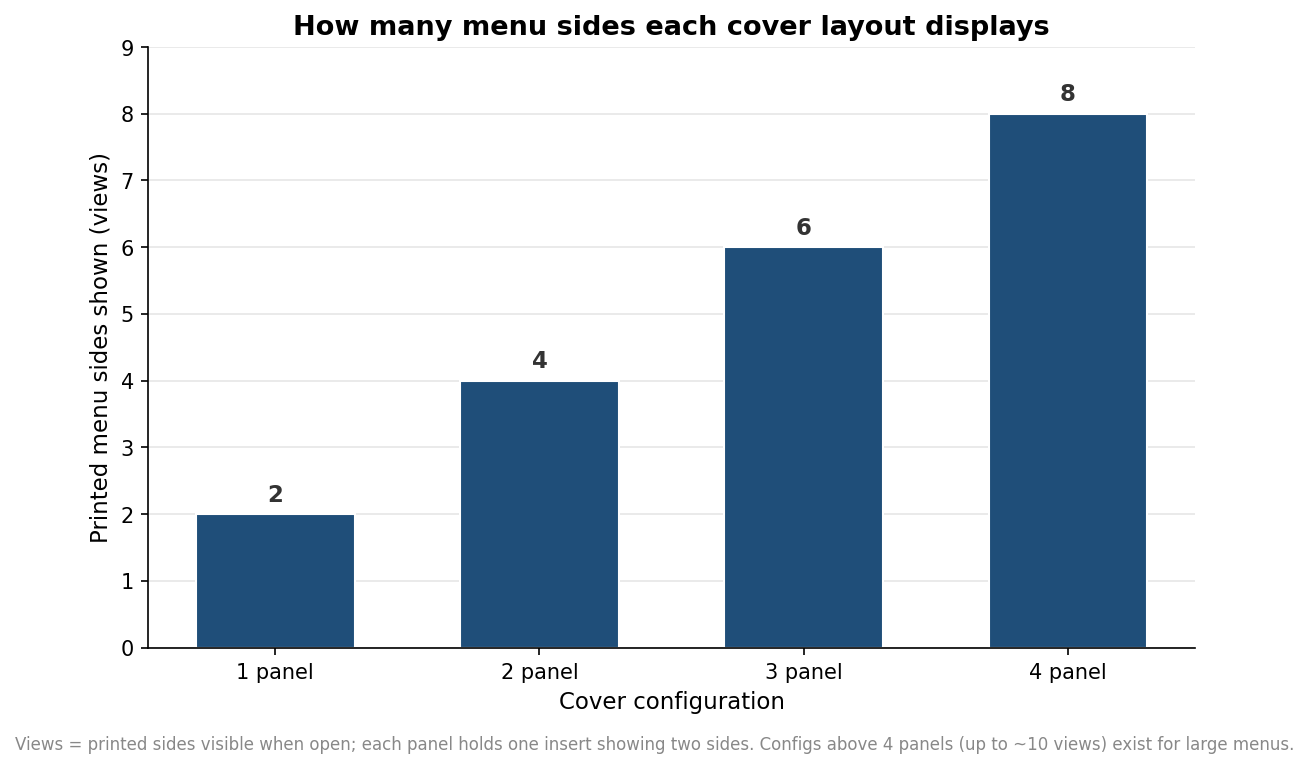
A useful rule of thumb: count the pages your current menu actually needs, add one for seasonal inserts, and round up to the next panel count. Ordering a cover that is one view too small is the most common reason a restaurant reprints within a year.
How the pages actually attach
The insert has to stay put, and the attachment method affects both durability and how quickly your staff can swap a menu. The default on most covers is four photo-album corners that grip each sheet at the edges; they are cheap, fast to change, and fine for a menu you update often. Sewn-in bands or clear strips hold the sheet along a whole edge and look tidier for a permanent menu. For covers that take real abuse, exposed or hidden screw posts and elastic cords lock inserts in hard and let you rebuild a booklet page by page, while sewn edges around the whole cover add stiffness and a finished border. If you reprint your menu monthly, favor corners or bands; if the menu rarely changes, screws and sewn construction will outlast them.
What you’ll pay, and where the money goes
Price tracks material and view count more than anything else. As a rough guide across the US market, a plain clear vinyl sleeve runs a few dollars, leatherette covers land in the low-to-mid double digits, and genuine leather can reach the price of a small booklet each, with full-grain hides at the top of that band. The ranges below are indicative single-unit figures, not a quote; custom foil stamping, debossing, extra panels, and bulk orders all move them. The two biggest cost multipliers are view count, because each added panel is more material and labor, and decoration, because a foil-stamped or blind-debossed logo adds a setup charge on the first order that then spreads across the quantity you buy.
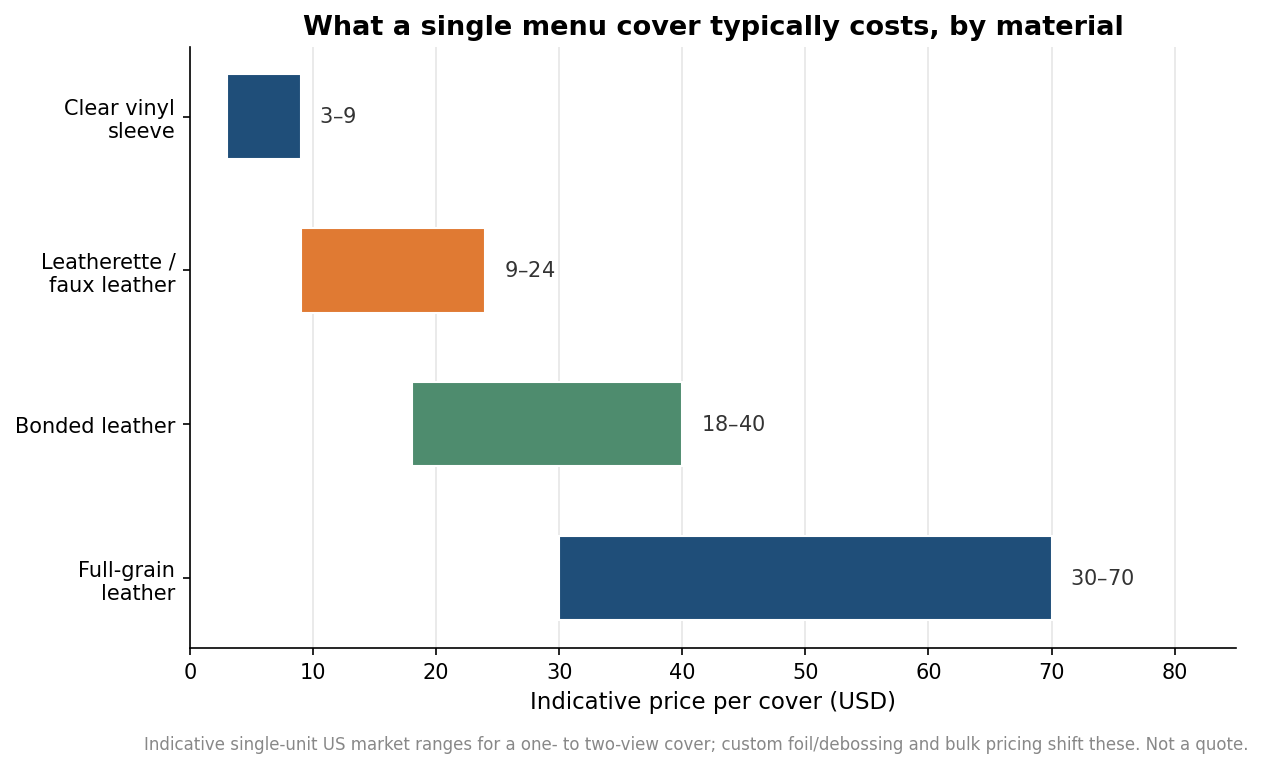
This is why buying in sensible quantity pays off. The one-time setup for a custom logo die is the same whether you order 12 covers or 60, so the per-cover decoration cost falls sharply as the run grows. If you know you will need replacements, ordering the spares up front is almost always cheaper than a second short run later.
Specifying a custom cover so it’s right the first time
When you move from a stock cover to a branded one, a few details prevent disappointment. Supply your logo as vector art so a foil die or deboss reproduces cleanly at any size, and decide early between shiny foil, which pops on dark leatherette, and blind deboss, which is subtler and more upscale on leather. Confirm the exact insert size and orientation, since a portrait 8.5 x 14 cover will not hold a landscape sheet. Ask for a physical proof or at least a photo of the first unit before the full run, and build in lead time: custom-decorated covers commonly take on the order of one to three weeks once artwork is approved, longer for genuine leather and large quantities. Nail those points and the cover you get back will match the room you pictured, and it will still look the part after a year of dinner service.