The cover almost never fails at the panel. It fails at the mechanism and the edge.
Customized Menu Covers makes slip-in, screw-post, elastic-cord, clear-pocket, fold-out and padded hardback covers — cut from your measured insert, with the mechanism and the edge chosen for how you reload and how you clean.
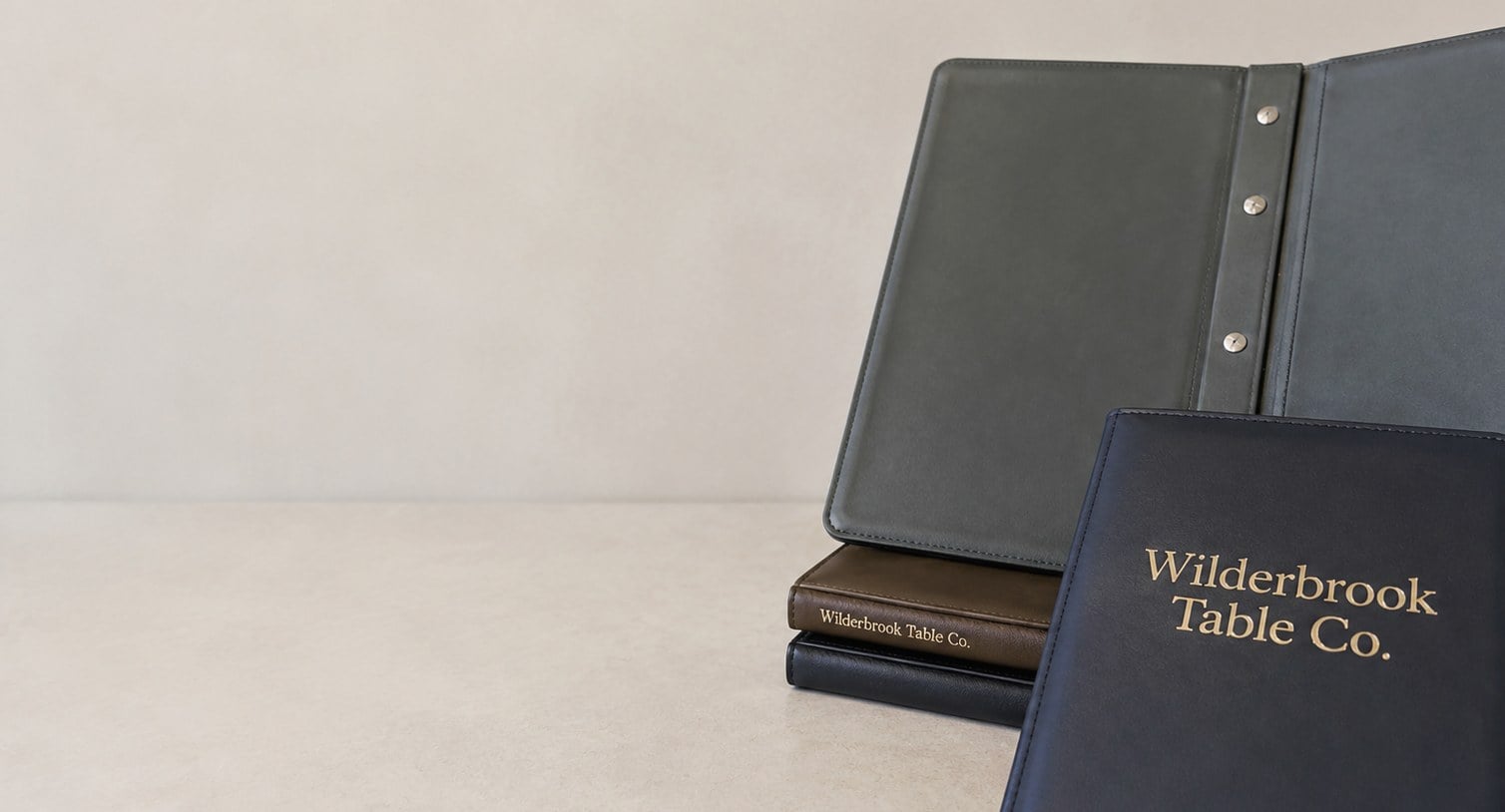
Menu covers are bought on a photograph and a size name, and both of those describe the part that was never going to be the problem.
What actually ends a cover’s life is smaller and duller than the panel: a corner slit that has torn the paper, a screw post somebody stripped in a hurry, a cord that will no longer hold a single sheet, a window clouded in a band across the middle, or a sealed edge that sanitiser has crept into.
None of that is bad luck. All of it is a mechanism chosen without anybody saying out loud how it fails.
Why we exist
Four things decide a menu cover: the measured insert, the attachment, the edge construction and the panel count. Only the last of those appears on a normal quote.
All four are settled before anything is cut, and none of them is expensive to get right.
Every standard size hides a quarter of an inch
Letter is not A4. A trimmed sheet is not the size it was ordered at. A laminated insert is measurably thicker than the same sheet unlaminated, and a pocket cut for paper bows the panel when it receives one.
So we ask for the actual insert, its measured dimensions and its finished thickness. That single step removes the white-margin complaint, the sheet that will not sit flat, and the corner that creases on every reload.
Every attachment fails, differently
Corner slits tear the paper at the corner. Sewn pockets cloud where they are wiped. Screw posts strip when a rushed reload meets the wrong screwdriver. Elastic cords slacken until they no longer hold a thin sheet. Rivets cannot be reloaded at all.
None of them is best. The right one is decided by who reloads the cover and how often, and we put the failure mode of the one we are recommending in writing before you buy.
It is wiped, not washed
A cover is now sanitised between guests, several dozen times a service, and the face of the panel is rarely what gives up first.
The edge is. A heat-sealed or painted edge is a seam, sanitiser wicks into a seam, and once it does the panel delaminates from the inside where no cleaning routine reaches. A turned-and-stitched edge has no seam to wick into, so we ask what is actually in your spray bottle and specify against it.
Opened width, not closed width
A three-panel fold-out on a letter insert opens past two feet, which is more than a two-top carrying glassware can take.
So we quote the opened width first, and where the table cannot carry it we will recommend two heavier panels instead of three light ones rather than selling the bigger cover.
What we will talk you out of
Corner slits on an uncoated stock reloaded weekly. A heat-sealed edge in a room that sprays alcohol between guests. A three-panel fold-out on small tables. Padded hardbacks for a counter-service room, where nobody will ever pick one up slowly enough to notice.
And a full printed menu programme — we print inserts to fit covers we are making, as a fit service, and nothing here is a food-contact, dishwasher-safe or antimicrobial article. Where you need a menu programme designed and cycled, that is a different specialism and we will say so.
How we work
ASK
Who reloads it, how often, and what is in the cleaning bottle.
MEASURE
Your actual insert, its dimensions and its finished thickness.
SPEC
Mechanism, edge construction, panel count and opened width.
MOCK
Free mockup within 24 hours.
SHIP
About 2 weeks, with the real date confirmed in writing before you commit.
Who we serve
Get in touch
Text or call George at (929) 605-4397, or email info@customizedmenucovers.com. Free mockups, low minimums, and a lowest-price guarantee.
Win Free Stuff
Enter below for a chance to win plus receive 10% off your first order.
🎉 You are in!
We will text you your 10% off code. Good luck!