A menu cover has a job that sounds simple and turns out to have half a dozen decisions hidden inside it: hold your printed menu, survive months of handling, and let a server swap a page when a price changes or a dish sells out. Specify it well and it does all three quietly for years. Specify it loosely and you end up with covers that fit the wrong sheet, bind in a way that fights your update schedule, or look heavier or flimsier than the room calls for. Here is how to work through the specification in the order that actually matters.
Start with the insert size, because everything follows from it
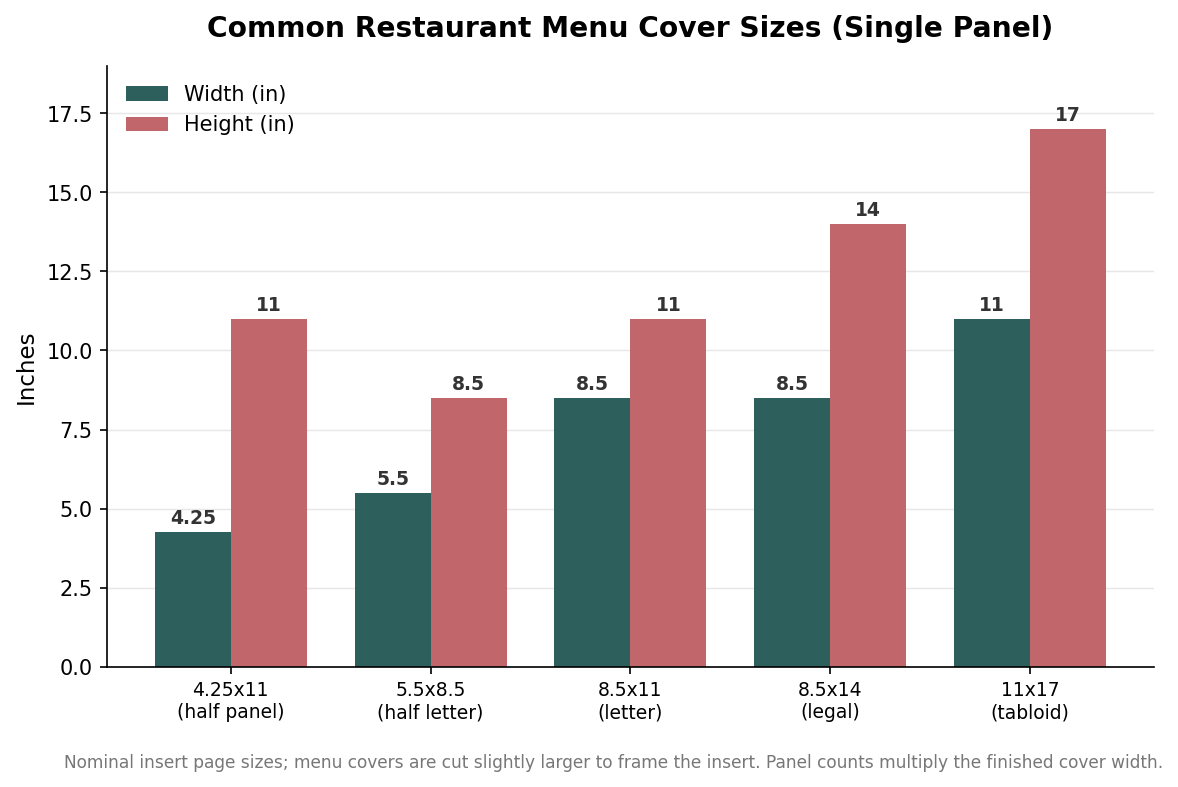
The first number to lock down is the size of the printed sheet the cover has to hold, since the cover is built around it. Letter, at 8.5 by 11 inches, is the versatile default and the easiest size to print in-house or at any shop. Legal, at 8.5 by 14, buys you extra vertical room for a longer food list without going to multiple panels. Half sizes such as 5.5 by 8.5 or a tall 4.25 by 11 suit compact food menus, cocktail lists, and dessert or beverage cards that live alongside the main menu. At the large end, tabloid at 11 by 17 gives an oversized single spread for venues that want the menu to read as a display piece. Decide this before anything else, because the cover is cut slightly larger than the insert to frame it, and every downstream choice assumes a fixed sheet size.
Choose the panel count to match how much you list
Once the sheet size is set, the number of panels or views determines total menu real estate. A single-panel cover shows one sheet, front and back, and reads as clean and minimal. A two-view opens like a folder to show two facing pages, which is the most common full-service format. Three-view and four-view configurations, sometimes built as gatefolds or booklets, hold three or four pages for larger menus that separate starters, mains, and drinks. Beyond that, multi-page formats using cords, rings, or bolts hold five or more pages for wine books and expanding lists. The rule of thumb is to size for your current menu plus one page of headroom, so a seasonal addition does not force a reprint of the whole cover format. It also helps to think about how the cover is handed to the guest: a single or two-view sits flat on the table and is easy for a server to carry a stack of, while a four-view or booklet reads as a more deliberate, higher-touch presentation that fits a slower dining pace.
The binding style is really a decision about updates
How the insert attaches to the cover looks like a cosmetic choice but is mostly about how often you change pages and how many you carry. Photo-corner and top-or-bottom flap styles hold a single sheet and let a server swap it in seconds, which is why they dominate in places that reprint daily specials. A picture-frame style that grips all four sides looks the most finished and holds the insert most securely, at the cost of a slightly slower change. When you need to carry several pages, the choice shifts to elastic cord, screw post, or ring binding. Elastic cord holds a small booklet and flexes as you add sheets; exterior screw posts let staff add or remove pages without opening the cover; ring binders carry the most pages and take the heaviest use, which is why they are the standard for wine and drink books.
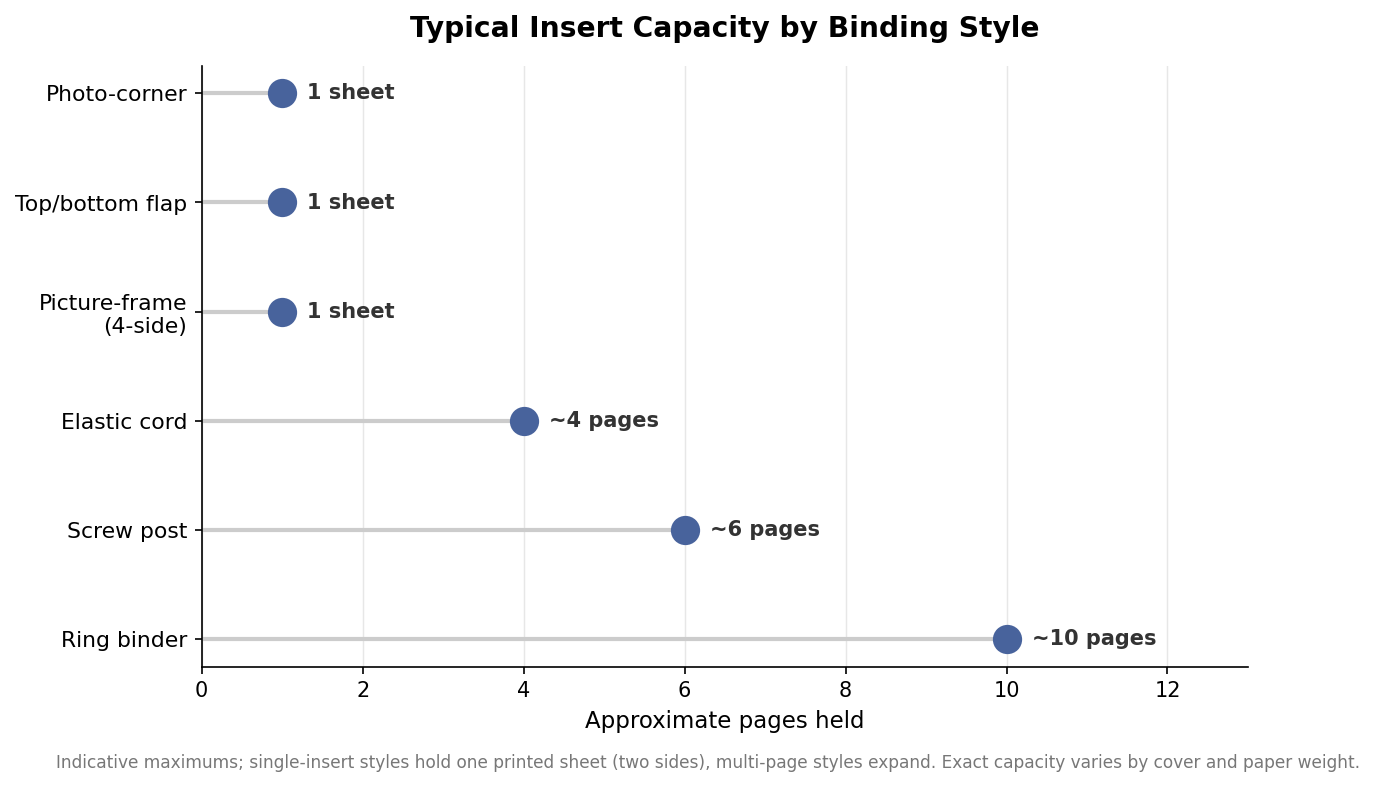
Read the chart above as a planning tool rather than a hard limit. The single-insert styles are built to hold one printed sheet showing two sides, and they are the right answer whenever your priority is a fast, tool-free page swap. The multi-page styles trade a little change-speed for capacity, and the practical maximum depends on the paper weight you print on, since heavier stock fills a binding faster than thin sheets.
Match the material and weight to the room
Material sets the durability and the impression, and it interacts with the format you have already chosen. Genuine leather and leatherette carry a premium, hospitality-grade feel and hold up to years of handling, while heavy vinyl and reinforced synthetics wipe clean and shrug off spills, which matters in high-turnover and outdoor-adjacent settings. A heavier cover reads as more upscale but adds weight that servers notice across a full shift, so a fine-dining captain’s book and a fast-casual table menu genuinely call for different builds. If your menus see food, moisture, and constant handling, a wipeable surface and a secure four-side or screw binding will outlast a delicate corner-mounted sheet, regardless of how nice the latter looks on day one.
Confirm the details before you order
Before you commit a run, put the full specification on one line so nothing is assumed: insert size in inches, panel or view count, binding style, material and color, and any imprint such as a logo blind-debossed or foil-stamped on the front. Confirm whether the quoted size is the insert size or the finished cover size, since the cover is always a little larger, and confirm that the inserts you plan to print will actually seat in the binding you chose. If several people at your venue will be swapping pages, factor in how tool-friendly the binding is, since an exterior screw post or a simple flap keeps updates in the hands of floor staff while an internal screw build may need a manager and a screwdriver. It is worth ordering a single sample in your intended material and binding before a full quantity, because a cover is something guests touch on every visit, and the difference between a good specification and a loose one shows up in exactly that moment.